In the realm of PHP development, understanding how interfaces can enforce properties through typed property declarations is crucial for Symfony developers seeking certification. Let's delve into this topic to enhance your knowledge and skills.
Exploring PHP Interfaces and Typed Properties
PHP interfaces provide a way to define a contract for classes to implement, ensuring a consistent structure. Typed properties, introduced in PHP 7.4, allow developers to specify the data type a property can hold. But can interfaces enforce these typed properties?
Let's explore this concept further with examples and scenarios relevant to Symfony development.
Understanding the Role of PHP Interfaces
Interfaces in PHP serve as a blueprint for classes, specifying methods that must be implemented. While interfaces traditionally do not define properties, can they enforce typed properties in PHP 7.4 and later versions?
<?php
interface TypedPropertyInterface {
    public int $id;
    public string $name;
}

// Error: Interfaces may not include properties
?>
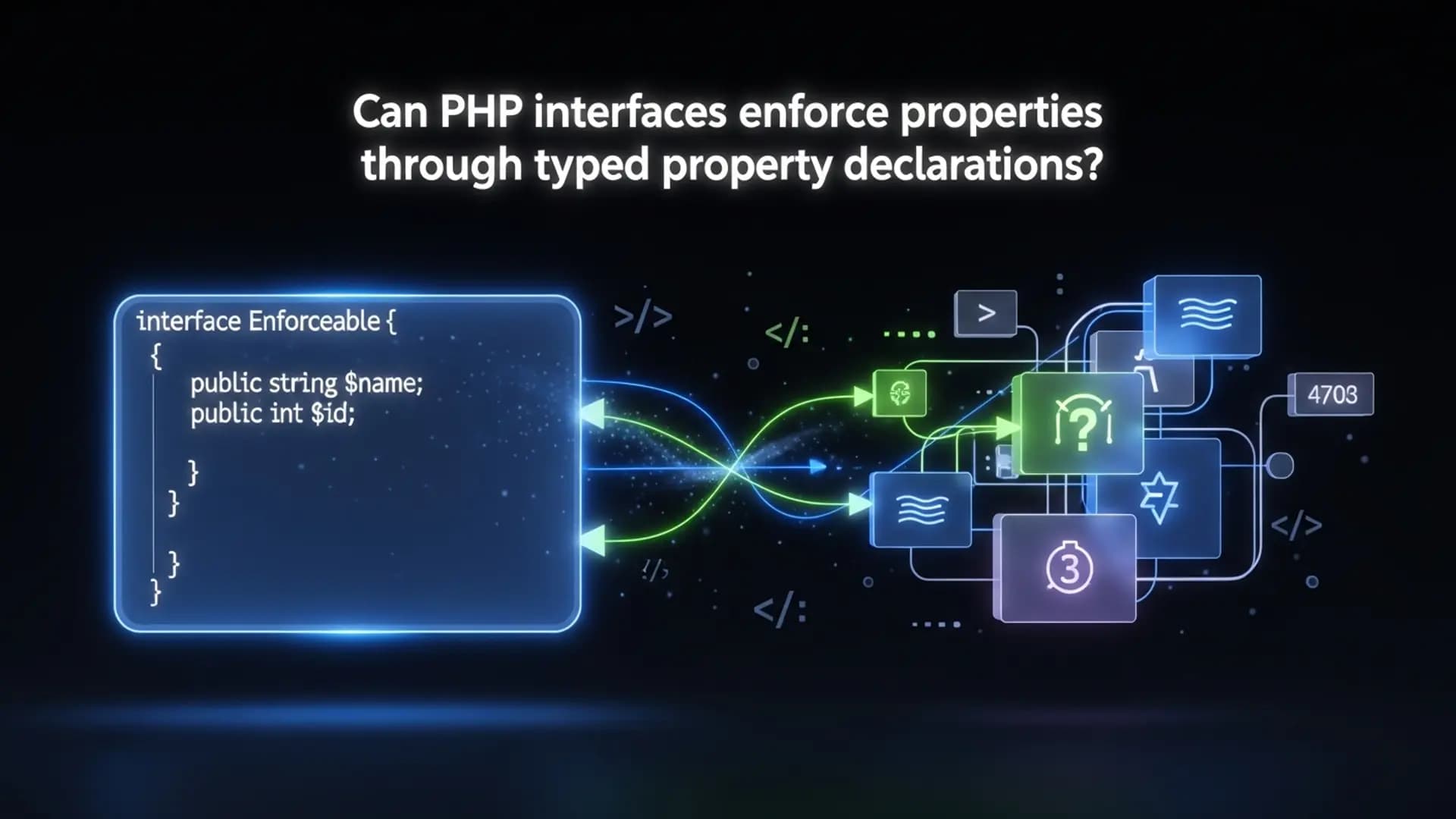
PHP interfaces, by design, do not support property declarations. However, the question remains: how can developers ensure consistent property types across classes implementing an interface?
Enforcing Typed Properties in Symfony Applications
In Symfony applications, maintaining data integrity and consistency is paramount. Consider a scenario where a service requires specific properties with defined types to function correctly. How can PHP interfaces play a role in enforcing these requirements?
Let's look at an example where a service interface mandates a class to have a certain typed property:
<?php
interface UserServiceInterface {
    public string $username;

    public function getUser(): User;
}

class UserRepository implements UserServiceInterface {
    public string $username; // Error: Cannot include property in class
    // Implement User retrieval logic
}
?>
While PHP interfaces cannot directly enforce typed properties, developers can use type hints in method signatures to ensure the correct property types are used in implementing classes.
Leveraging Type Hinting in Symfony Development
Symfony embraces type hinting to enhance code readability and maintainability. By specifying parameter and return types in method signatures, developers can communicate expectations clearly. How can this practice align with enforcing property types through interfaces?
Consider a Twig template that relies on a specific object structure:
{# TWIG TEMPLATE #}
{{ user.username }}

{# Error: Property 'username' does not exist on object #}
By defining interfaces for objects passed to Twig templates and using type hinting, developers can ensure that the required properties are present and of the correct type, preventing runtime errors.
Enhancing Doctrine Queries with Typed Properties
When working with Doctrine in Symfony, constructing queries that rely on specific entity properties is common. How can typed properties and interfaces aid in building robust Doctrine queries?
Consider a scenario where a DQL query requires entities with specific properties:
<?php
interface OrderInterface {
    public int $orderId;
    public string $status;
}

// DQL Query
$query = $entityManager->createQuery('SELECT o FROM App\Entity\Order o WHERE o.status = :status');
$query->setParameter('status', 'pending');
?>
By defining interfaces for entities and ensuring typed properties, developers can write more robust queries and catch potential errors at compile time, enhancing the overall reliability of Doctrine queries.
Conclusion: Advancing Your Symfony Skills
While PHP interfaces do not enforce properties through typed declarations, leveraging type hinting in method signatures and embracing consistent data structures through interfaces can elevate your Symfony development practices. By understanding how to ensure property types across classes, you can write more robust, maintainable code in Symfony applications.