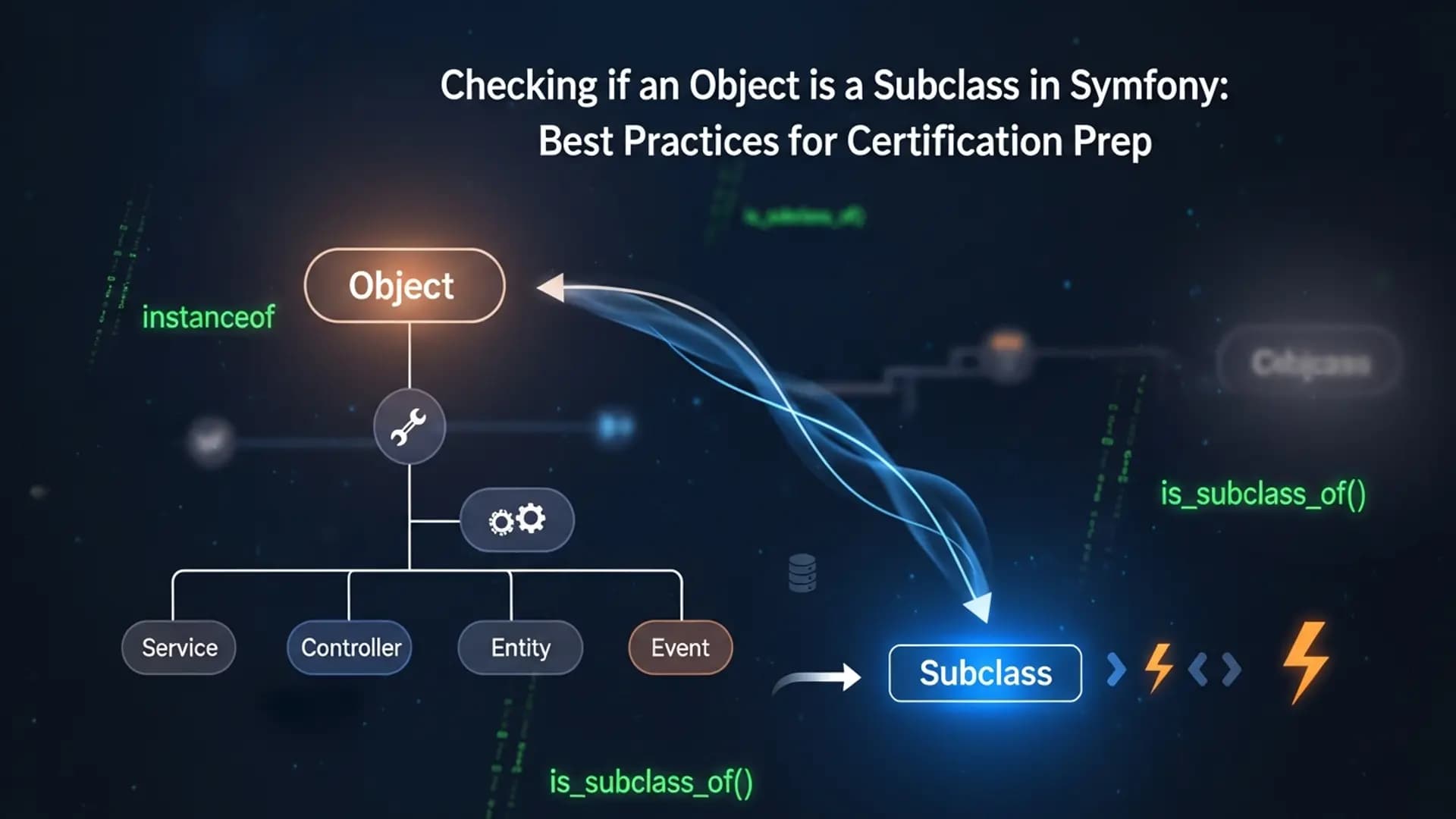
As a Symfony developer preparing for the certification exam, understanding how to check if an object is a subclass of a specific class is essential for building robust and efficient Symfony applications. In this blog post, we will delve into this topic, explore practical examples within Symfony applications, and provide best practices to help you master this concept.
Understanding Subclass Checking in Symfony
In object-oriented programming, the ability to determine if an object is a subclass of a specific class is crucial for implementing polymorphic behavior and ensuring code integrity. This concept allows developers to make informed decisions based on the type hierarchy of objects within their applications.
Practical Examples in Symfony
Consider a scenario where you need to validate that an object is an instance of a specific subclass before performing certain operations. In Symfony, this can be commonly encountered when defining complex conditions in services, implementing logic within Twig templates, or constructing Doctrine DQL queries.
<?php
use App\Entity\User;

$user = $this->getUser();

if ($user instanceof User) {
    // Perform actions specific to User subclass
} else {
    // Handle other cases
}
?>
In the above example, we check if the current user object is an instance of the User subclass before executing specific logic tailored for User entities. This practice ensures that the code behaves as expected and avoids potential errors.
Best Practices for Subclass Checking
When working with subclass checking in Symfony, it is essential to follow best practices to maintain code clarity and consistency. Here are some guidelines to consider:
Best Practice 1: Utilize the
instanceofoperator to determine subclass relationships accurately.Best Practice 2: Consider using type hints in method signatures to enforce specific subclass requirements.
Best Practice 3: Document subclass relationships in class comments for better code understanding and maintainability.
Common Pitfalls to Avoid
In Symfony development, certain pitfalls can arise when checking for subclass relationships. By being aware of these pitfalls, you can write more reliable and efficient code. Some common pitfalls include:
Pitfall 1: Incorrectly assuming subclass relationships without proper validation.
Pitfall 2: Overcomplicating subclass checks by introducing unnecessary conditions.
Pitfall 3: Neglecting to update subclass checks when refactoring code or introducing new classes.
Conclusion: Mastering Subclass Checking for Symfony Certification
In conclusion, understanding how to check if an object is a subclass of a specific class is a fundamental skill for Symfony developers preparing for the certification exam. By incorporating best practices, avoiding common pitfalls, and applying this knowledge in real-world Symfony applications, you can demonstrate proficiency in object-oriented programming and enhance your chances of exam success.