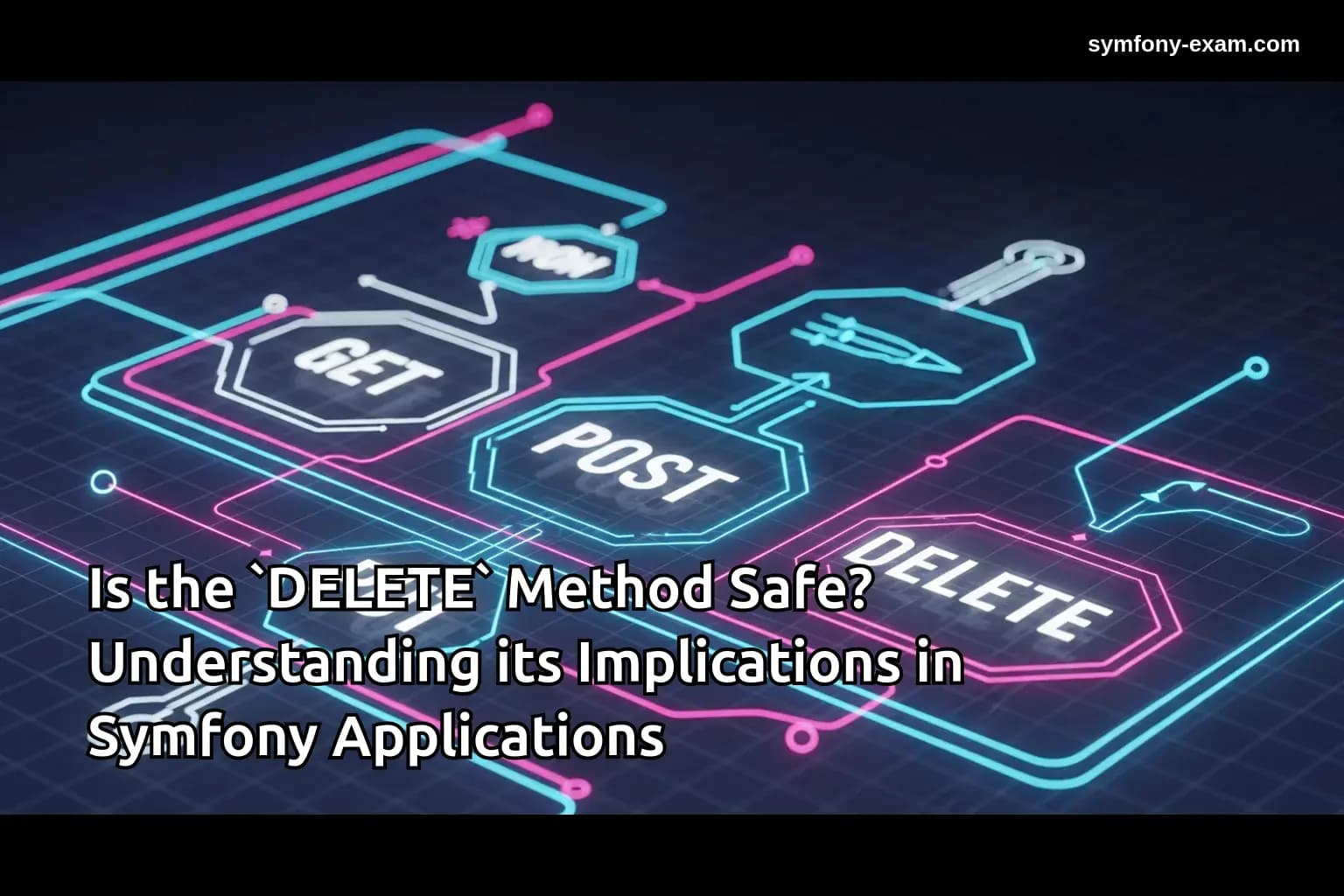
In the realm of Symfony development, understanding the safety of HTTP methods like DELETE is crucial. This article explores whether the DELETE method is safe and the implications it has for developers, particularly those preparing for the Symfony certification exam.
Understanding HTTP Methods
HTTP methods are the building blocks of web communication. Each method serves a different purpose. The most commonly used methods include:
GET: Retrieve resources.
POST: Submit data to be processed.
PUT: Update existing resources.
DELETE: Remove resources.
Is the DELETE Method Safe?
When discussing the safety of the DELETE method, it's essential to understand its intended use. Unlike GET and HEAD, which are considered safe (they do not modify resources), the DELETE method is inherently unsafe since it can alter the state of the server by removing resources.
In technical terms, the DELETE method is classified as unsafe and idempotent. This means that while multiple DELETE requests will have the same effect as a single request (removing a resource), they can still modify the state of the server, thus not adhering to the definition of a safe method.
Practical Examples in Symfony
In a Symfony application, the DELETE method is often used in controllers to handle resource removal. Consider the following example:
<?php
// src/Controller/ProductController.php

namespace App\Controller;

use App\Entity\Product;
use Doctrine\ORM\EntityManagerInterface;
use Symfony\Bundle\FrameworkBundle\Controller\AbstractController;
use Symfony\Component\HttpFoundation\Response;
use Symfony\Component\Routing\Annotation\Route;

class ProductController extends AbstractController
{
    /**
     * @Route("/product/`{id}`", methods={"DELETE"})
     */
    public function delete(EntityManagerInterface $entityManager, Product $product): Response
    {
        $entityManager->remove($product);
        $entityManager->flush();

        return new Response(null, Response::HTTP_NO_CONTENT);
    }
}
In this example, a DELETE request to the route /product/{id} will trigger the removal of a specified product. However, developers must ensure that this action is protected against unauthorized access, as a simple DELETE request can lead to significant data loss if misused.
Handling Safety Concerns
To mitigate risks associated with the DELETE method, consider implementing the following strategies:
1. Authorization Checks: Ensure that only authorized users can perform DELETE operations. For example:
<?php
// Example authorization check
if (!$this->isGranted('DELETE', $product)) {
    throw $this->createAccessDeniedException('You do not have permission to delete this product.');
}
2. Soft Deletes: Instead of permanently removing records, consider implementing soft deletes where a record is marked as deleted but not actually removed from the database. This can be achieved using a boolean flag in your entity.
3. Confirmation Mechanism: Implement a confirmation step in your UI before executing a DELETE request to prevent accidental deletions.
Logic in Twig Templates
When rendering DELETE actions in Twig templates, it is essential to ensure that users do not inadvertently trigger these actions. For example, a typical delete button might look like this:
twig
{# templates/product/delete.html.twig #}
<form action="{{ path('product_delete', { 'id': product.id }) }}" method="post" onsubmit="return confirm('Are you sure you want to delete this product?');">
    <button type="submit">Delete</button>
</form>
In this example, a JavaScript confirmation dialog is presented to the user before they can proceed with the deletion. This additional layer helps prevent accidental deletions, reinforcing the importance of safety when using the DELETE method.
Building Doctrine DQL Queries
When using Doctrine's DQL, it’s crucial to ensure that DELETE operations are executed with care. Here’s an example of a DQL query to delete products:
php
$query = $entityManager->createQuery('DELETE FROM App\Entity\Product p WHERE p.id = :id');
$query->setParameter('id', $productId);
$query->execute();
This DQL statement executes a DELETE operation directly in the database. While efficient, it’s essential to validate the $productId to ensure that the correct resource is being targeted.
Best Practices for Safe DELETE Operations
Here are some best practices to follow when implementing DELETE operations in your Symfony applications:
1. Validate Input: Always validate and sanitize incoming data, especially identifiers used in DELETE queries.
2. Use Transactions: Consider wrapping DELETE operations in transactions to maintain data integrity.
3. Implement Logging: Log deletion actions to keep track of who deleted what and when, which can help in audits and debugging.
Conclusion: The Importance of Understanding DELETE Method Safety
In conclusion, while the DELETE method is essential for managing resources in Symfony applications, it is inherently unsafe due to its potential to alter server state. Developers must implement stringent safety measures, including authorization checks, confirmation mechanisms, and thoughtful design patterns like soft deletes. Understanding these nuances is critical for developers preparing for the Symfony certification exam, as they reflect a deep comprehension of secure coding practices.
For more information on related topics, check out the following articles:
.