How to Identify Invalid 5xx Server Error Status Codes in Symfony
As a Symfony developer preparing for certification, understanding HTTP status codes is crucial. These codes not only inform clients about the result of their requests but also help you diagnose issues within your applications. Among these codes, server error status codes (5xx) indicate that the server failed to fulfill a valid request. This article will guide you through identifying which of the following is NOT a valid status code for a server error, emphasizing its importance in Symfony development.
The Importance of HTTP Status Codes
HTTP status codes are three-digit responses from the server to a client's request, providing essential information about the outcome of that request. For Symfony developers, these codes play a vital role in:
- Error Handling: Understanding the nature of the error helps you debug and resolve issues efficiently.
- Client Feedback: Proper status codes ensure clients understand what went wrong and how to rectify it.
- API Development: For RESTful APIs developed with Symfony, returning the appropriate status codes is critical for client-side error handling.
Common Server Error Status Codes
Before identifying the invalid status codes, let’s review some common server error status codes:
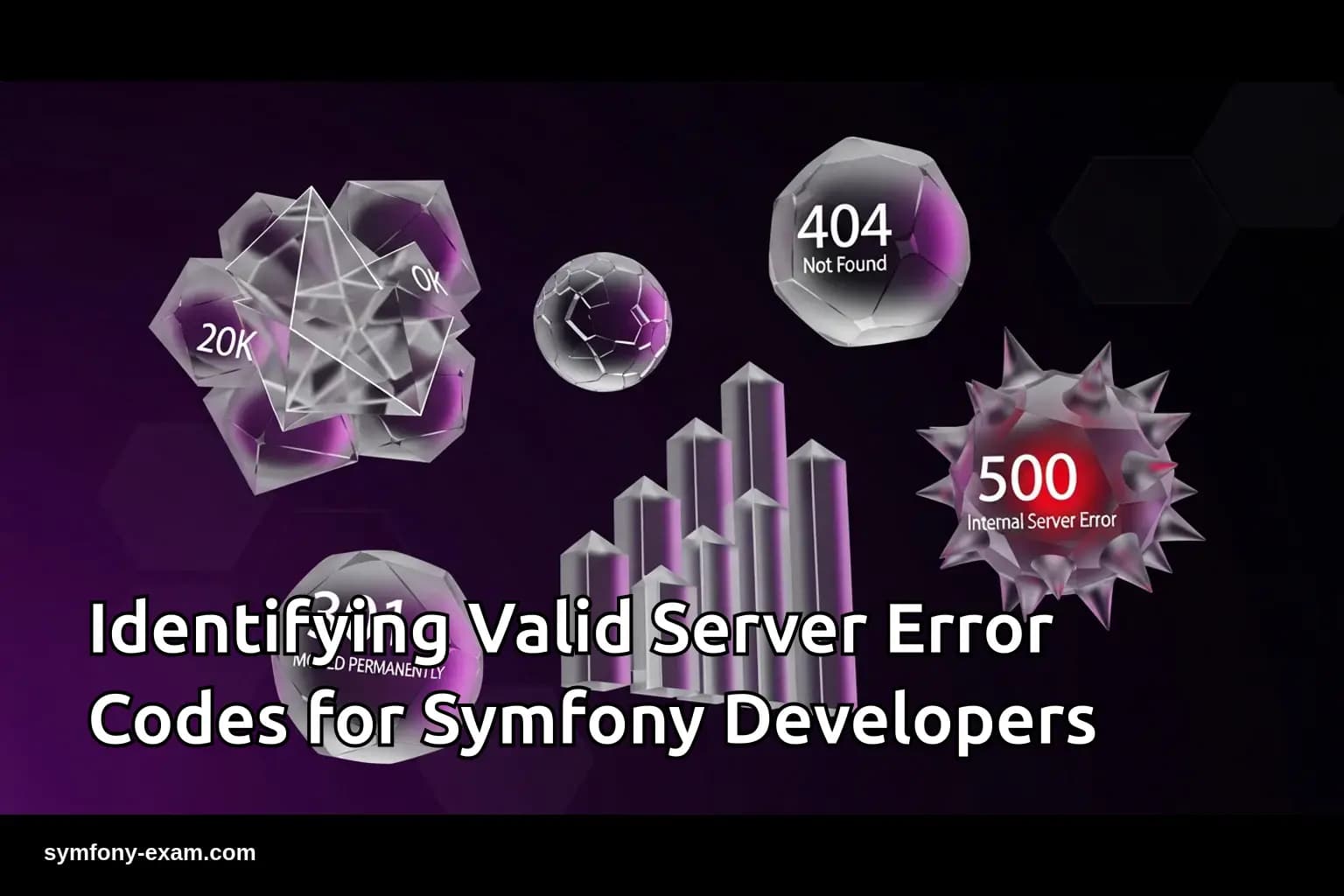
- 500 Internal Server Error: A generic error message indicating that something has gone wrong on the server.
- 501 Not Implemented: The server does not support the functionality required to fulfill the request.
- 502 Bad Gateway: The server received an invalid response from the upstream server while acting as a gateway.
- 503 Service Unavailable: The server is currently unable to handle the request due to temporary overload or maintenance.
Understanding these codes is essential when developing Symfony applications, especially when dealing with complex conditions in services, logic within Twig templates, or building Doctrine DQL queries.
Identifying Invalid Server Error Status Codes
What Makes a Status Code Invalid?
A status code is considered invalid if it does not fit within the defined ranges for HTTP status codes. Specifically, server error status codes fall within the range of 500 to 599. Any code outside this range, even if it follows the correct three-digit format, does not qualify as a valid server error status code.
Examples of Invalid Status Codes
Let’s look at a few examples of codes that are NOT valid server error status codes:
- 400 Bad Request: This code indicates that the request could not be understood by the server due to malformed syntax. It is a client error, not a server error.
- 401 Unauthorized: This code indicates that authentication is required and has failed or has not yet been provided. It is also a client error.
- 404 Not Found: This code signifies that the server has not found anything matching the request URI. This is a client error as well.
- 200 OK: This code indicates a successful request and is a standard response for successful HTTP requests. It is not a server error.
From the above list, we can conclude that codes such as 400, 401, 404, and 200 are NOT valid server error status codes.
Practical Examples in Symfony Applications
Handling Errors in Symfony Controllers
In Symfony, you often handle errors within your controllers. For instance, you might want to return a server error response under specific conditions. Here’s how you can implement error handling in a Symfony controller:
use SymfonyComponentHttpFoundationResponse;

class UserController extends AbstractController
{
    public function createUser(Request $request): Response
    {
        // Simulate a server error scenario
        if (/* some condition that causes an error */) {
            return new Response('Internal Server Error', 500);
        }

        // Otherwise, process the request normally
        // ...
    }
}
In this example, if a specific error condition is met, a 500 Internal Server Error response is returned. This is a valid use of a server error status code.
Error Handling in Services
You may also encounter scenarios where services throw exceptions that you want to handle gracefully. Here’s an example of how you can catch exceptions and return appropriate status codes:
use SymfonyComponentHttpFoundationResponse;
use DoctrineORMEntityNotFoundException;

class UserService
{
    public function findUser(int $id): User
    {
        try {
            return $this->userRepository->findOrFail($id);
        } catch (EntityNotFoundException $e) {
            return new Response('User not found', 404); // Client error
        } catch (Throwable $e) {
            return new Response('Internal Server Error', 500); // Server error
        }
    }
}
In the above service method, an attempt is made to find a user by ID. If the user is not found, a 404 Not Found response is returned. However, if an unexpected error occurs, a 500 Internal Server Error response is issued, which aligns with server error handling.
Twig Template Logic
When rendering templates in Symfony, you might want to customize the error messages based on the status code. Here’s an example of how you can handle different status codes in a Twig template:
{% if status_code == 500 %}
    <h1>Internal Server Error</h1>
    <p>We encountered an unexpected error. Please try again later.</p>
{% elseif status_code == 404 %}
    <h1>Page Not Found</h1>
    <p>The page you are looking for does not exist.</p>
{% else %}
    <h1>Unexpected Error</h1>
    <p>An unexpected error occurred. Please contact support.</p>
{% endif %}
In this Twig template, different messages are displayed based on the status_code variable. It’s important to ensure that the server error codes are correctly identified and handled.
Conclusion
Understanding which status codes are valid for server errors is essential for Symfony developers, especially when preparing for certification. In this article, we explored common server error status codes, identified invalid codes, and examined practical examples within Symfony applications.
As a developer, being able to recognize and correctly implement these status codes enhances your ability to build robust web applications that handle errors gracefully. This knowledge not only aids in certification preparation but also improves the overall quality of your Symfony projects.
By mastering HTTP status codes, you are better equipped to handle complex conditions in services, manage logic within Twig templates, and build efficient Doctrine DQL queries. Keep this information in mind as you continue your journey toward Symfony certification success.