As a Symfony developer aiming for certification, understanding object-oriented features in PHP is crucial for building robust and maintainable applications. This blog post will delve into the key concepts and practical examples to help you grasp these essential programming principles.
What are Object-Oriented Features in PHP?
Object-oriented programming in PHP involves the use of classes, objects, inheritance, encapsulation, and polymorphism. These features allow developers to create modular, reusable, and organized code.
Let's explore each of these concepts in detail to understand their significance in PHP development.
Classes and Objects
In PHP, a class serves as a blueprint for creating objects. Objects are instances of classes that encapsulate data and behavior. They allow for the implementation of real-world entities in code.
For example, in a Symfony application, you might have a User class representing users with properties like name, email, and role.
Inheritance and Polymorphism
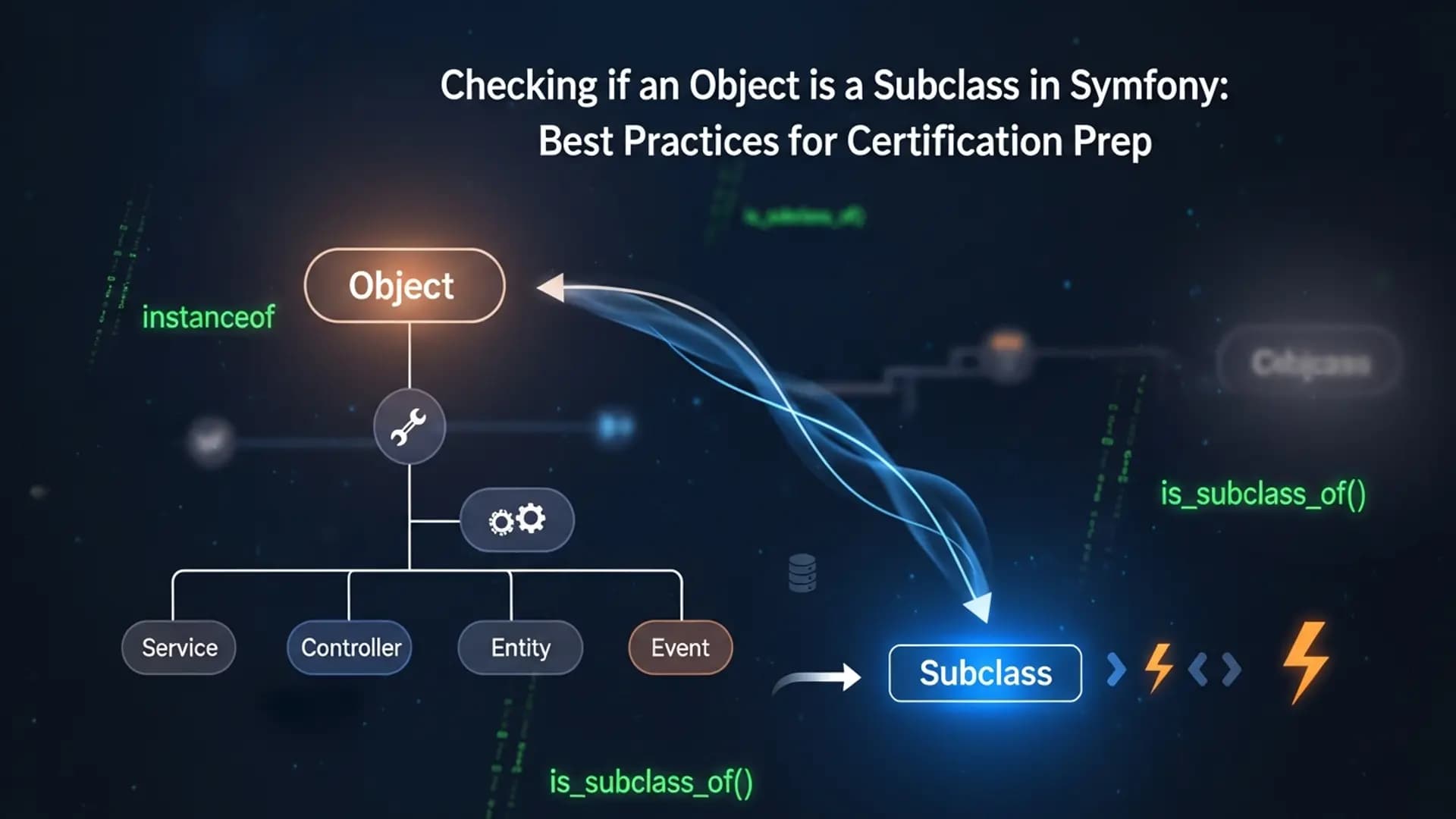
Inheritance enables classes to inherit properties and methods from parent classes, promoting code reuse. Polymorphism allows objects of different classes to be treated as instances of a common superclass.
For instance, in Symfony, you might have a base Controller class with common methods inherited by specific controller classes.
Encapsulation
Encapsulation restricts access to class members, preventing external interference and ensuring data integrity. It promotes information hiding and modularity in code.
In a Symfony service, encapsulation helps in defining private properties and methods accessible only within the service.
Which of the following is NOT an object-oriented feature in PHP?
Among the given options, one feature does not align with object-oriented programming principles in PHP. Let's analyze each choice to identify the outlier.
-
Inheritance
-
Encapsulation
-
Procedural Programming
-
Polymorphism
Based on your understanding of object-oriented features, can you determine which option deviates from the norm?
Practical Symfony Examples
Consider scenarios in Symfony applications where object-oriented features play a vital role. From defining services with complex dependencies to utilizing inheritance in entity classes, object-oriented principles are ubiquitous.
Let's explore a hypothetical example where encapsulation is crucial in a Symfony service:
<?php
// Example of encapsulation in a Symfony service
class UserService
{
    private $userRepository;

    public function __construct(UserRepository $userRepository)
    {
        $this->userRepository = $userRepository;
    }

    public function getUserById($userId)
    {
        return $this->userRepository->find($userId);
    }
}
?>
Common Pitfalls and Best Practices
Avoiding procedural programming and embracing object-oriented practices is essential for Symfony developers. Here are some common pitfalls to watch out for:
Best Practice 1: Embrace inheritance and polymorphism to promote code reuse and flexibility.
Best Practice 2: Utilize encapsulation to protect data and ensure the integrity of your application.
Best Practice 3: Avoid mixing procedural code with object-oriented code for consistency and maintainability.
Conclusion: Mastering Object-Oriented Features for Symfony Success
By understanding and applying object-oriented features in PHP, you elevate your Symfony development skills and set yourself up for success in certification exams. Object-oriented programming principles form the foundation of modern PHP development, enabling you to build scalable and maintainable applications.